Details of the SKOS Subset CSV (SKOS-SC) format

Term Descriptions

SKOS Subset CSV (SKOS-SC) format

This vocabulary CSV format is designed for easy understanding of users who are not familiar with knowledge processing such as RDF.

It is also a CSV file format stored in a vocabulary repository (see below).

The following two types of the SKOS Subset CSV (SKOS-SC) format are available:

  • Data that describes relationships between terms in a controlled vocabulary (hereinafter “SKOS-SC term list”)
  • Metadata that describes the names and creators of controlled vocabularies (hereinafter “basic vocabulary information”)

Simple vocabulary creation support tool: Simple Vocabulary Designer (SVD)

This WEB application supports creation of controlled vocabularies in each field.

Source code
/src/Tools/SVD/IMI3-Vocabulary-SimpleDesigner_Ver3.4.zip(released as OSS)

Vocabulary repository

This repository (a storage place where data, files and other items are managed centrally) is used to build vocabularies and allows the user to register, search and view vocabularies freely.

Detailed description
Website for SIP cross-domain data exchange platform “Vocabulary Repository”(https://sip-cyber-x.jp/overview/o003)

SVD, Vocabulary Repository and SKOS-SC Format

▼Conceptual image of SKOS-SC format integration between SVD and vocabulary repository

Controlled vocabularies can also be created and edited without using SVD, by editing files in the SKOS-SC format on Excel. The following explanation is supplementary information about how to edit files in the SKOS-SC format by using Excel.

About “SKOS-SC Term List”

SKOS-SC Term List have the following columns:
▲Example of entries in the SKOS-SC Term List

Explanation of each column

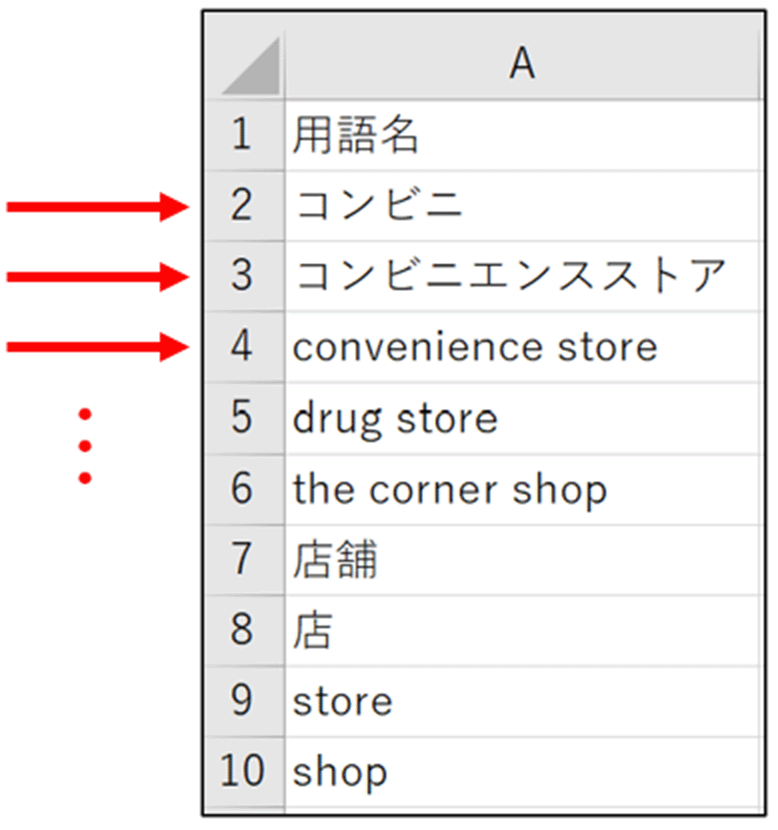
Terms (用語名) Column

  • List of terms in the target field
  • One term is entered in each row with no duplicates

Enter a term in each row with no duplicate
Representative word (代表語) Column

  • Term that represents its synonyms in the target field, if any, for display purposes
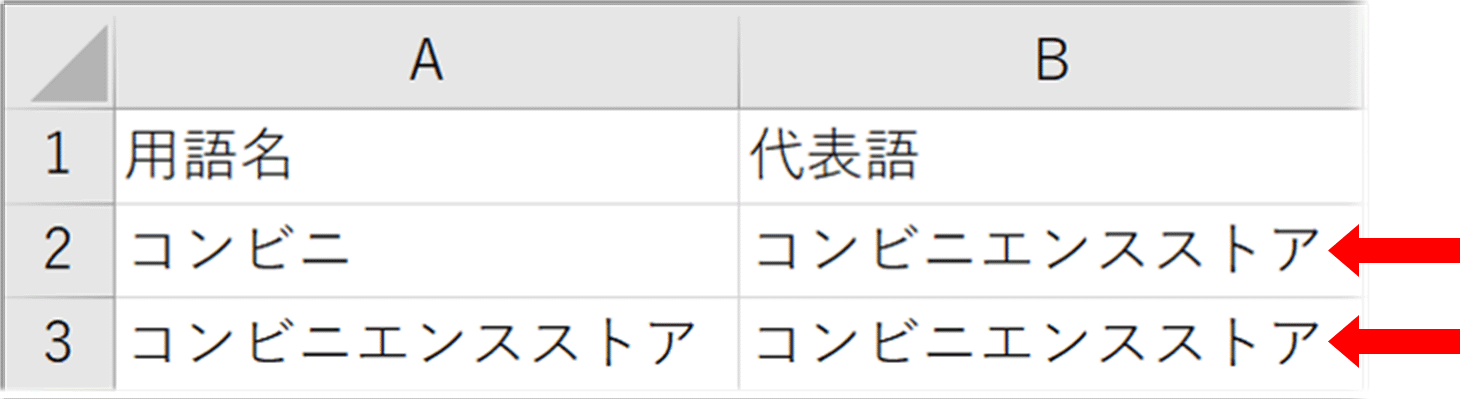
  • In an example of entries in the simplified file format, “convenience store (コンビニエンスストア)” is the representative word of both “conbini (コンビニ)” and “convenience store (コンビニエンスストア).” This expresses that “conbini (コンビニ)” and “convenience store (コンビニエンスストア)” are synonyms and their representative word is “convenience store (コンビニエンスストア).”

If there are terms in a synonymous relationship, the same representative word is entered repeatedly as in this case
  • One representative word is selected from the terms in each synonymous relationship and entered. In this example, either “conbini (コンビニ)” or “convenience store (コンビニエンスストア)” should be entered as their representative word and no other term should be entered.
  • If a term has no synonym, the term itself is selected as the representative word and entered in the Representative word (代表語) Column.

Language (言語) Column

  • Information about the language used in the target field
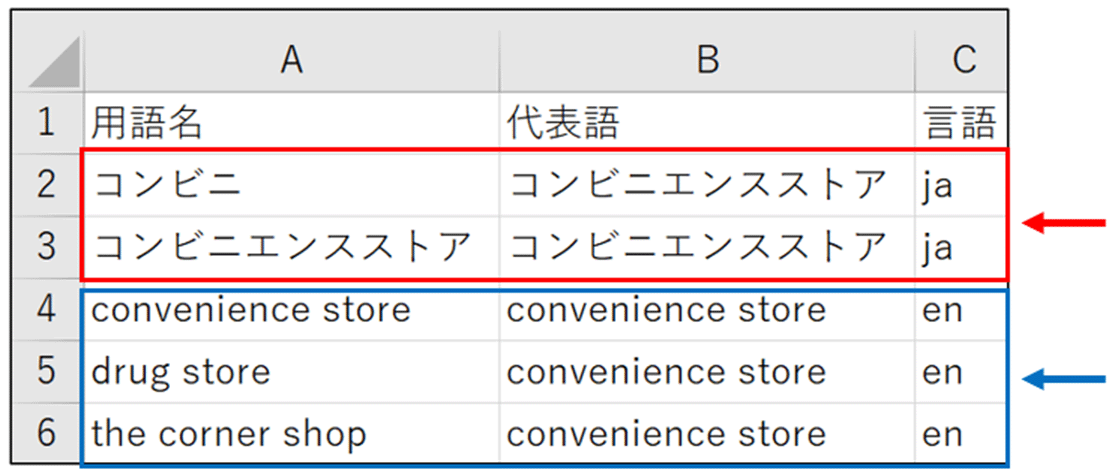
  • When the terms are in Japanese, “ja” is entered. When they are in English, “en” is entered (other languages are not supported).
  • Terms in each synonymous relationship should have a uniform representative word by language

“convenience store (コンビニエンスストア)” is the representative word in “ja”

“convenience store” is the representative word in “en”

URI of representative word (代表語のURI) Column

  • Unique value held by each representative word of terms in the target field
  • It is expressed in the combination of the URI of that vocabulary and the ID of the representative word (the ID does not have to be a number)
  • * The URI of each vocabulary is the same as the URI of the vocabulary in the “basic vocabulary information.”
  • There is no particular restriction on how to express the URI of each vocabulary and the ID of each representative word (however, a slash should be entered between the URI of the vocabulary and the ID of the representative word)
  • URI must be entered for each representative word
  • The same URI is entered for all of the representative words in each synonymous relationship
The following terms are synonyms:
conbini (コンビニ)
convenience store (コンビニエンスストア)
convenience store
drug store
the corner shop
The following terms are synonyms:
store (店舗)
shop (店)
store
shop
[Supplementary information] About URI
URI is an abbreviation for “Uniform Resource Identifier,” which is a character string described according to a certain format and an identifier used to recognize any kind of resource.

URI of hypernym (上位語のURI) Column

  • URI of the representative word for each hypernym of terms in the target field
  • The same “URI of hypernym (上位語のURI)” is entered for the terms in each synonymous relationship
  • It is entered only if a hypernym exists (and can be omitted)

Terms such as “store (店舗)” with http://myVocabulary/2 as the URI of their representative word are hypernyms of terms such as “conbini (コンビニ)” with http://myVocabulary/1 as the URI of their representative word

There is no entry, because terms such as “store (店舗)” with http://myVocabulary/2 as the URI of their representative word have no particular hypernym

URI of synonym in other vocabulary systems (他語彙体系の同義語のURI) Column

  • URI of a term that has a synonymous relationship with each term in a vocabulary that is different from the vocabulary in the target field
  • The same “URI of synonym in other vocabulary systems (他語彙体系の同義語のURI)” is entered for all of the terms in each synonymous relationship
  • It is entered only if there is any term in a synonymous relationship in another vocabulary (and can be omitted)

The “URI of synonym in other vocabulary systems (他語彙体系の同義語のURI)” of terms such as “store (店舗)” with http://myVocabulary/2 as the URI of their representative word is http://otherVocabulary/16 (and there is no available information other than this URI)

There is no entry, because terms such as “conbini (コンビニ)” with http://myVocabulary/2 as the URI of their representative word have no synonym in other vocabulary systems

Term description (用語の説明) Column

  • Description of each term in the target field
  • The same term description is entered for the terms in each synonymous relationship by language
  • It can be omitted

Description of synonyms such as “convenience store,” “drug store” and “the corner shop”

There is no description of synonyms such as “store (店舗)” and “shop (店)”

There is no description of synonyms such as “store” and “shop”

Description of synonyms such as “conbini (コンビニ)” and “convenience store (コンビニエンスストア)”

About “Basic Vocabulary Information”

▼Example of entries in “basic vocabulary information”

Explanation of each column

Vocabulary name (語彙の名称) Column

  • Japanese name of each controlled vocabulary
  • Any name is entered

English name of vocabulary (語彙の英語名称) Column

  • English name of the controlled vocabulary
  • Any name is entered

Version (バージョン) Column

  • Version of the controlled vocabulary

Prefix (接頭語) Column

  • Expression by simplifying the URI of the controlled vocabulary
  • As a prefix may be used to describe the controlled vocabulary in RDF, it can be simplified without using a long URI character string repeatedly

URI of vocabulary (語彙のURI) Column

  • URI of the controlled vocabulary
  • It can be expressed freely
  • It must be entered

Vocabulary description (語彙の説明) Column

  • Description of the controlled vocabulary in Japanese
  • The controlled vocabulary is described here

English description of vocabulary (語彙の英語説明) Column

  • Description of the controlled vocabulary in English
  • The controlled vocabulary is described in English

Creator of vocabulary (語彙の作成者) Column

  • Person who created the controlled vocabulary
  • It can be entered freely